

DDQ Solver is a built-in workflow. Your admin can hide built-in workflows or restrict access. If you do not see it under Workflows, ask your Metal admin or contact support@metal.ai.
Before you begin
Choose source material that your firm has approved for this use. A good source set is:- Current, with superseded versions removed or clearly separated.
- Narrow enough to avoid conflicting answers across unrelated funds or strategies.
- Complete enough to cover firm, fund, investment process, operations, compliance, and reporting questions.
- Permissioned for everyone who will run or review the DDQ.
Prepare the DDQ bank
Prepare your approved answer sources in the DDQ bank before the first run:1
Open the bank
Go to Workflows → DDQ Solver, then click Manage Bank.
2
Choose the bank boundary
Under Bank folder, select the folder that contains the approved DDQ material. Nested folders remain within that bank boundary.
3
Index the source files
In Sources, select the files or folders you want to use and index anything marked as missing. Wait for processing to finish before starting a questionnaire.
4
Check the entries
Use Entries to search the generated question-and-answer material. Filter to a source file when you need to inspect where an entry came from. Reindex a file after its approved content changes.
Start a DDQ run
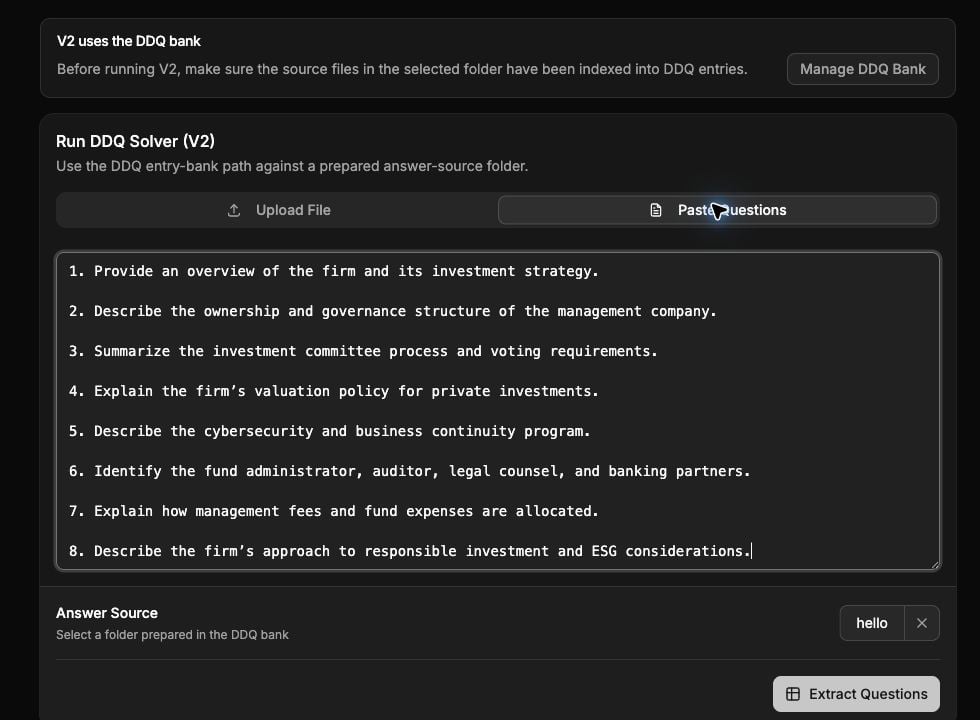
The current DDQ Solver uses a prepared DDQ bank. This staging example uses eight fictional questions and an approved-answer source with fictional Northwind content.
1
Open DDQ Solver
Go to Workflows → DDQ Solver. Click Run DDQ Solver (V2).
2
Provide the questions
Choose Upload File or Paste Questions. File uploads support PDF, DOCX, TXT, XLSX, XLS, and CSV files up to 10 MB.
3
Choose the answer source
Under Answer Source, select the prepared DDQ Bank folder or source folder that should bound the search.
4
Extract the questions
Click Extract Questions. Metal creates the run and extracts the questionnaire into individual questions.
Review questions and generate answers
On the run page:- Review the extracted questions before answering begins.
- Remove headings, instructions, duplicates, or other rows that are not questions when the remove control is available.
- Click Start Answering. Metal processes each question against the selected answer source.
- Follow the progress counts for processed, answered, unanswered, and errored questions.
- If the run fails, review the error and use Retry after correcting the source or input problem.
Review the response
Treat the generated output as a sourced draft, not an automatically approved external response.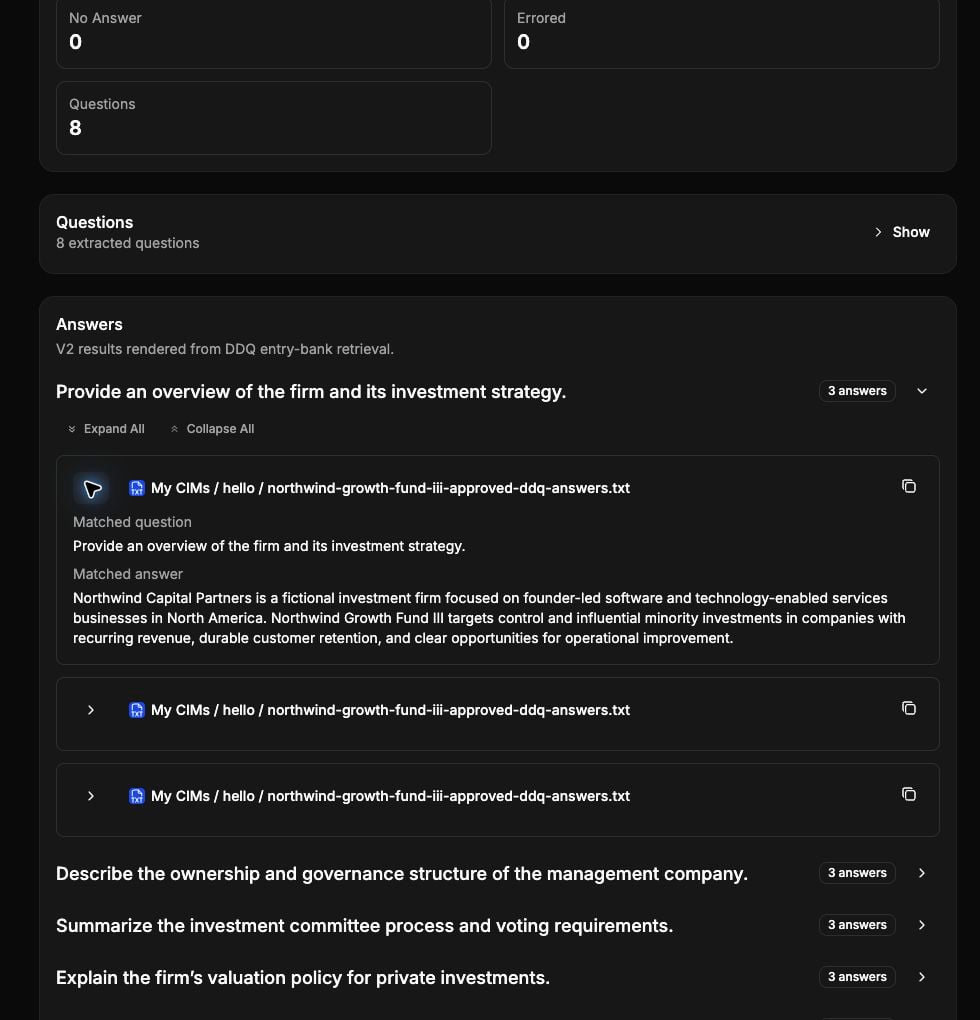
A completed DDQ Solver run shows processing status, retrieved answers, and the source material behind each draft. All data shown here is fictional.
- Read every answer for accuracy, scope, and fund-specific relevance.
- Open the supporting citation to inspect the source document and page.
- Investigate No answer found instead of filling the gap with an assumption.
- Escalate conflicting or outdated source material to the content owner.
- Confirm that legal, compliance, performance, and commercial statements have the required human approval.
Export the completed questionnaire
When the answer and export phases finish, click Download Export on the run page. Open the downloaded file and complete your firm’s final formatting and approval process before sending it externally. Past runs remain available under Workflows → DDQ Solver. Use them to understand what was answered and which source material supported the run.Troubleshooting
No prepared source folders appear
Open Manage DDQ Bank, select a bank folder, and index its source files. A folder becomes available to the current DDQ flow after it contains prepared DDQ entries.A source document is inaccessible
You need permission to the selected source material. Ask the workspace or folder owner to grant access, then reopen the run.Many questions return no answer
Check that you selected the correct fund or strategy folder, that its files finished indexing, and that the source material actually contains approved answers. Expand the source boundary only when the additional material belongs in the response context.The questionnaire does not extract cleanly
Remove decorative sheets, instructions, and merged layouts where practical, or use Paste Questions to provide a clean question set directly.Related
Run fundraising
Put DDQs into the broader IR and capital formation process.
Working with documents
Organize and permission the source material Metal uses.
Run workflows
Learn how workflow runs, outputs, artifacts, and permissions work.