

Discovered values
Whenever Metal finds a value for a field, it records it as a discovered value with its provenance:
A field keeps every discovered value, so nothing is lost when sources disagree.
How ranking works
To choose the value it displays, Metal ranks the discovered values. Ranking weighs:- Source priority — the order of sources configured under Settings → Enrichment. Higher-priority connections win ties.
- Confidence — values Metal is more confident in rank higher.
- Recency — more recent values are preferred when sources are otherwise comparable.
- User input — a value a person set or confirmed is treated as authoritative.
Pinning and overrides
When you want a specific value regardless of ranking, pin it. A pinned value takes precedence over automatic reconciliation and stays put through future enrichment runs until you unpin it. This is how you correct or lock in a value your firm has verified.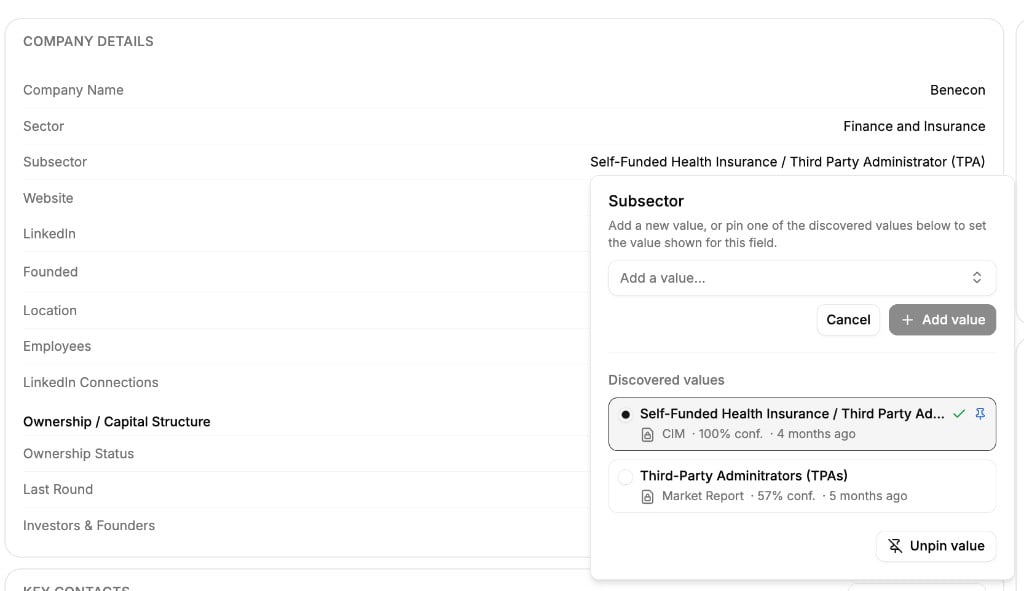
Pin a value to override ranking; unpin to return to automatic reconciliation.
Why it matters
Trust every value
Each displayed value traces back to a source, a confidence score, and a date — so you can defend it in diligence.
No lost context
Conflicting inputs are kept and ranked, not discarded, so you can see what every source said.
Your firm stays in control
Pin verified values to override automation where your judgment should win.
Sources you choose
Prioritize the connections your firm trusts, and reconciliation follows that order.
Over the API, each resource returns the reconciled displayed value on the attribute itself. See Companies and the API reference for the enriched fields available on each resource.