> ## Documentation Index
> Fetch the complete documentation index at: https://docs.metal.ai/llms.txt
> Use this file to discover all available pages before exploring further.
# Reconciliation & ranking
> How Metal ranks discovered values from many sources and reconciles them into one trusted value.
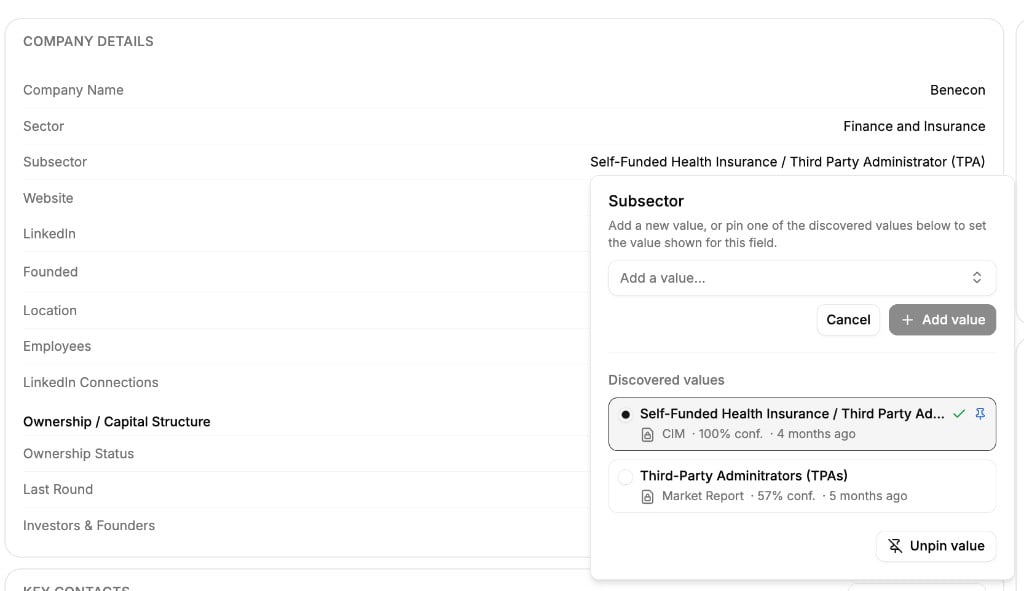
A single attribute — a company's subsector, revenue, or ownership status — is often reported differently across a CIM, a market report, a web source, and your CRM. Reconciliation is how Metal turns those conflicting inputs into one trusted value, without throwing away the alternatives. It's a core part of what makes [enriched](/concepts/enrichment) data dependable.
## Discovered values
Whenever Metal finds a value for a field, it records it as a **discovered value** with its provenance:
| Attribute | Description |
| ---------- | --------------------------------------------------------------------------------------------------------------- |
| Value | The value itself. |
| Source | Where it came from — a document (for example, a CIM), a market report, web search, third-party data, or a user. |
| Confidence | How confident Metal is in the value, as a percentage. |
| Recency | When the value was discovered. |
A field keeps every discovered value, so nothing is lost when sources disagree.
## How ranking works
To choose the value it displays, Metal ranks the discovered values. Ranking weighs:
* **Source priority** — the order of sources configured under **Settings → Enrichment**. Higher-priority connections win ties.
* **Confidence** — values Metal is more confident in rank higher.
* **Recency** — more recent values are preferred when sources are otherwise comparable.
* **User input** — a value a person set or confirmed is treated as authoritative.
The top-ranked value becomes the **displayed value** — the one returned by the API and shown across the app.
## Pinning and overrides
When you want a specific value regardless of ranking, **pin** it. A pinned value takes precedence over automatic reconciliation and stays put through future enrichment runs until you unpin it. This is how you correct or lock in a value your firm has verified.
 ## Why it matters
Each displayed value traces back to a source, a confidence score, and a date — so you can defend it in diligence.
Conflicting inputs are kept and ranked, not discarded, so you can see what every source said.
Pin verified values to override automation where your judgment should win.
Prioritize the connections your firm trusts, and reconciliation follows that order.
Over the API, each resource returns the reconciled displayed value on the attribute itself. See [Companies](/concepts/data-model#companies) and the [API reference](/api-reference/introduction) for the enriched fields available on each resource.
## Why it matters
Each displayed value traces back to a source, a confidence score, and a date — so you can defend it in diligence.
Conflicting inputs are kept and ranked, not discarded, so you can see what every source said.
Pin verified values to override automation where your judgment should win.
Prioritize the connections your firm trusts, and reconciliation follows that order.
Over the API, each resource returns the reconciled displayed value on the attribute itself. See [Companies](/concepts/data-model#companies) and the [API reference](/api-reference/introduction) for the enriched fields available on each resource.