> ## Documentation Index
> Fetch the complete documentation index at: https://docs.metal.ai/llms.txt
> Use this file to discover all available pages before exploring further.
# Enrichment
> How Metal enriches companies with firmographics, financial metrics, and signals from AI providers, web search, and your uploaded documents.
Enrichment fills in what your firm doesn't already know. Metal combines AI with data providers and your own documents to populate attributes such as firmographics, [financial metrics](/concepts/financial-metrics), headcount, and signals on the resources you track.
Every enriched attribute keeps its provenance. Metal collects candidate values from many sources, ranks and [reconciles](/concepts/reconciliation) them into a single best value, and shows you the citation behind each one.
## How enrichment works
When you enrich a company, Metal gathers data from multiple sources, ranks and reconciles conflicting values, and writes the result back to the record. Enrichment runs asynchronously: you trigger it, and the enriched values appear on the record once processing completes.
Call the enrich endpoint for a company.
```bash theme={"theme":{"light":"github-light","dark":"github-dark"}}
curl -X POST https://api.metal.ai/v1/companies/665f1c2a9b1e4a0012a3b4c5/enrich \
-H "x-metal-client-id: $METAL_CLIENT_ID" \
-H "x-metal-api-key: $METAL_API_KEY"
```
Metal queries providers and AI models, then reconciles the results into a single best value per attribute.
Fetch the company again to read the enriched fields, such as `sector`, `description`, financials, and timestamps like `lastEnrichedAt`.
Enrichment is asynchronous. After triggering it, poll the company record (or wait for a [webhook](/guides/webhooks) if configured) rather than expecting enriched values in the immediate response.
## Discovered values and citations
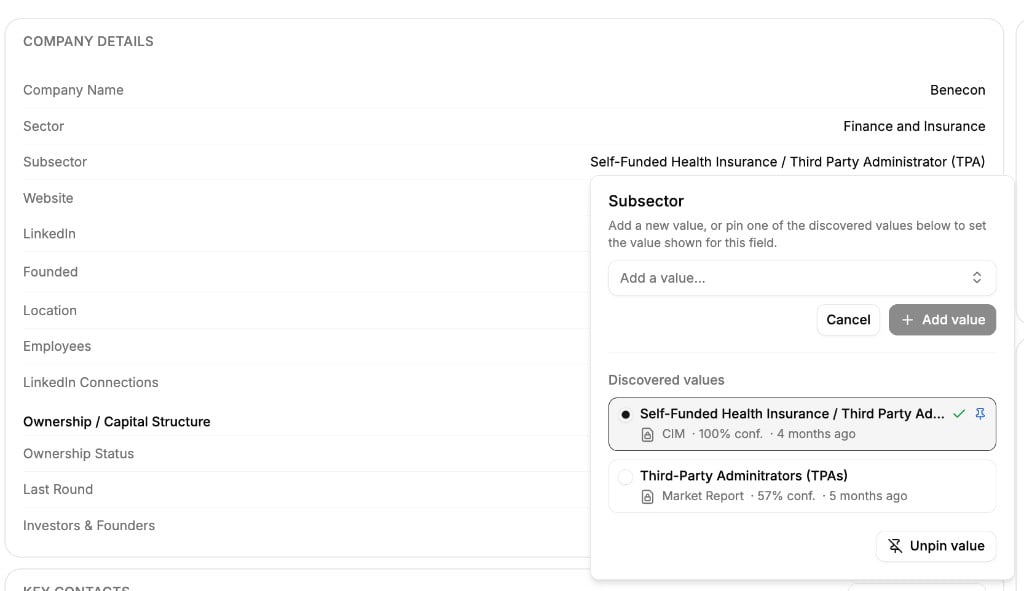
For each attribute, Metal keeps every value it has discovered — not just the one it displays. Each discovered value carries its **source**, a **confidence** score, and **when** it was found, so you can always trace a value back to where it came from.
Metal [reconciles and ranks](/concepts/reconciliation) these candidates into a single displayed value. You can override the choice by **pinning** a specific value, which takes precedence over future enrichment until you unpin it.
 ## Sources and what gets enriched
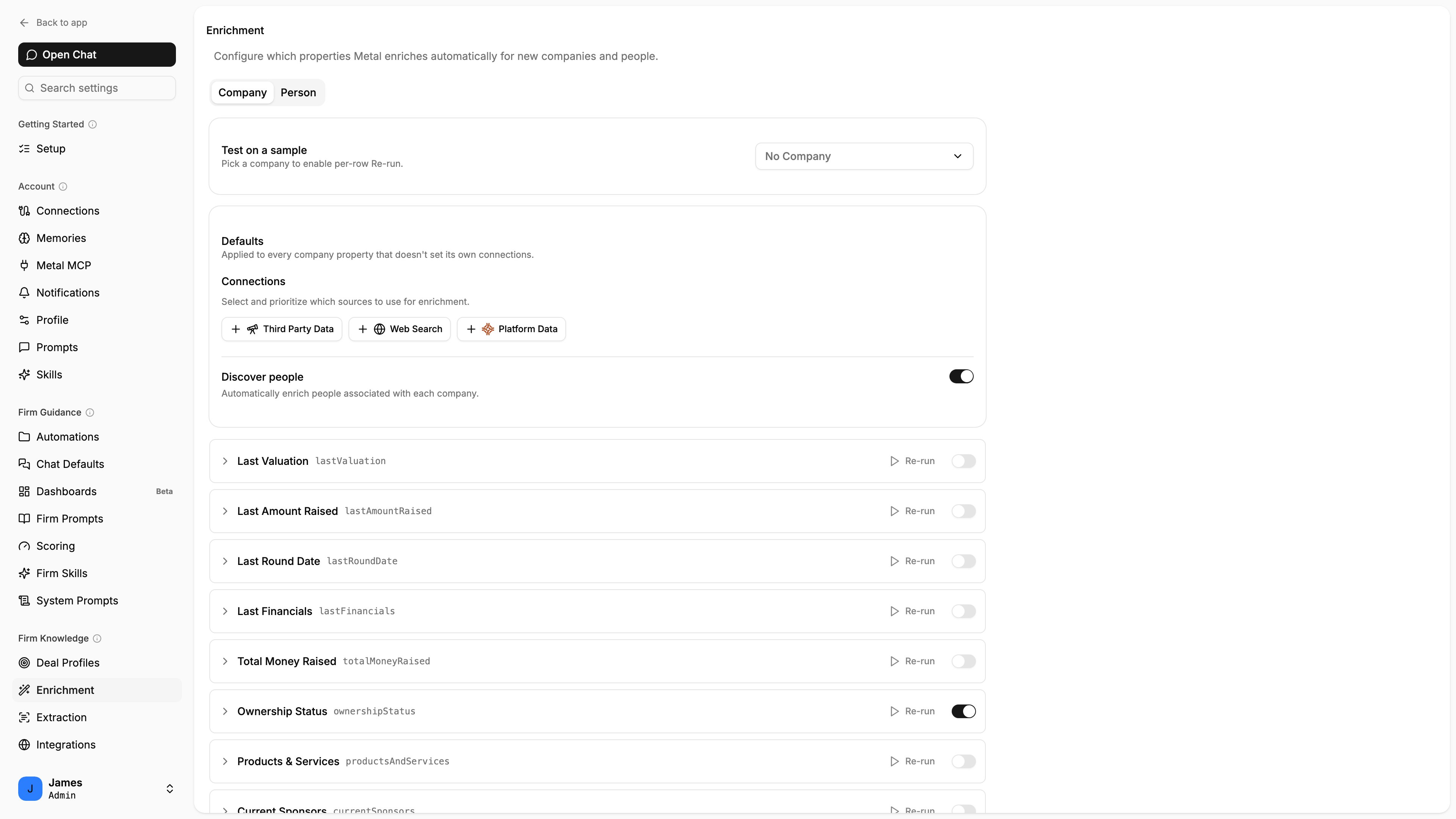
An admin controls which attributes Metal enriches and which sources it draws from under **Settings → Enrichment**. Sources are prioritized — Metal prefers higher-priority connections when it reconciles conflicting values.
## Sources and what gets enriched
An admin controls which attributes Metal enriches and which sources it draws from under **Settings → Enrichment**. Sources are prioritized — Metal prefers higher-priority connections when it reconciles conflicting values.
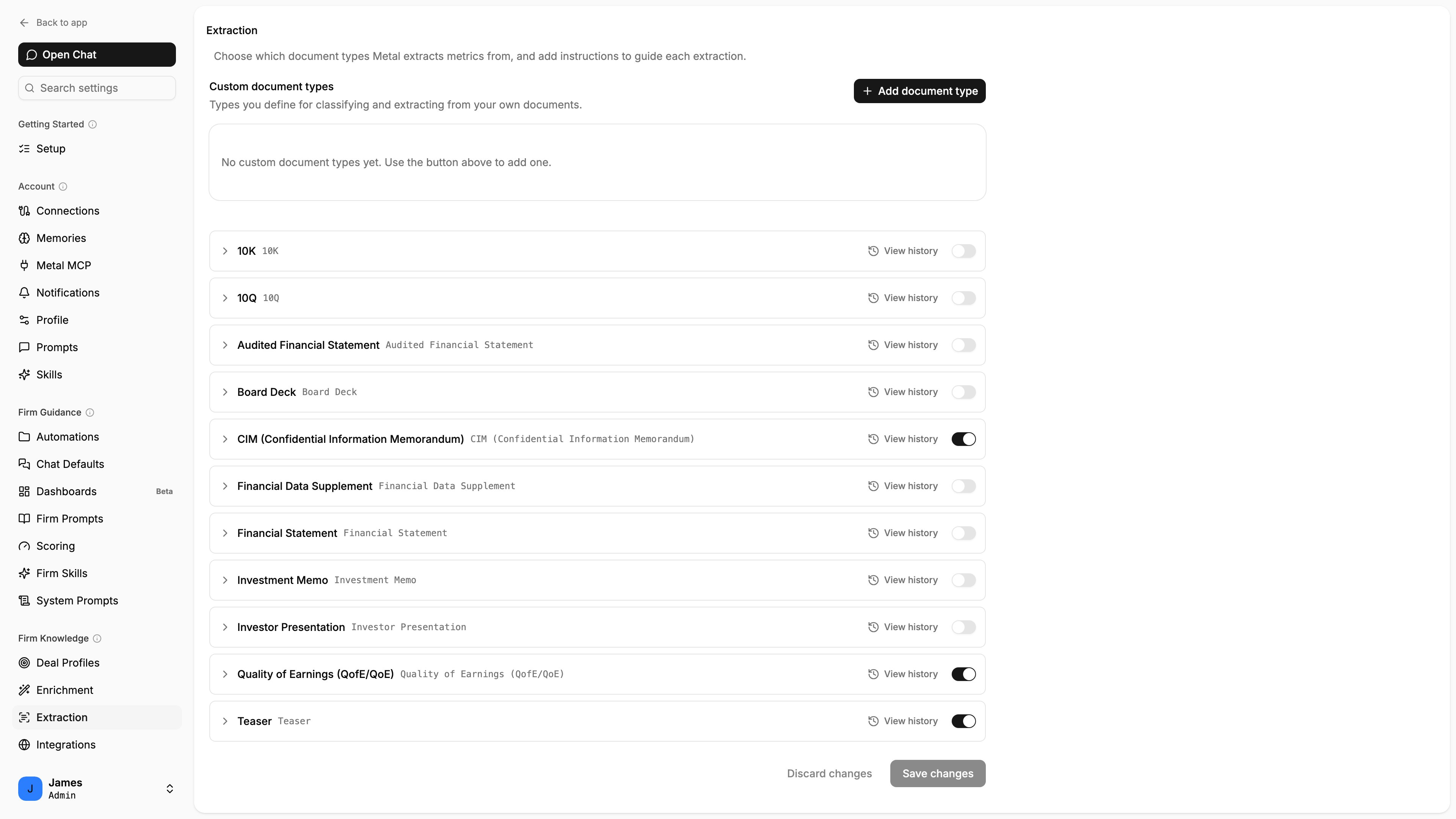
 Beyond third-party data and web search, Metal extracts values from your own documents — CIMs, financial statements, board decks, and more. An admin chooses which document types to extract from and can add instructions to guide each extraction under **Settings → Extraction**.
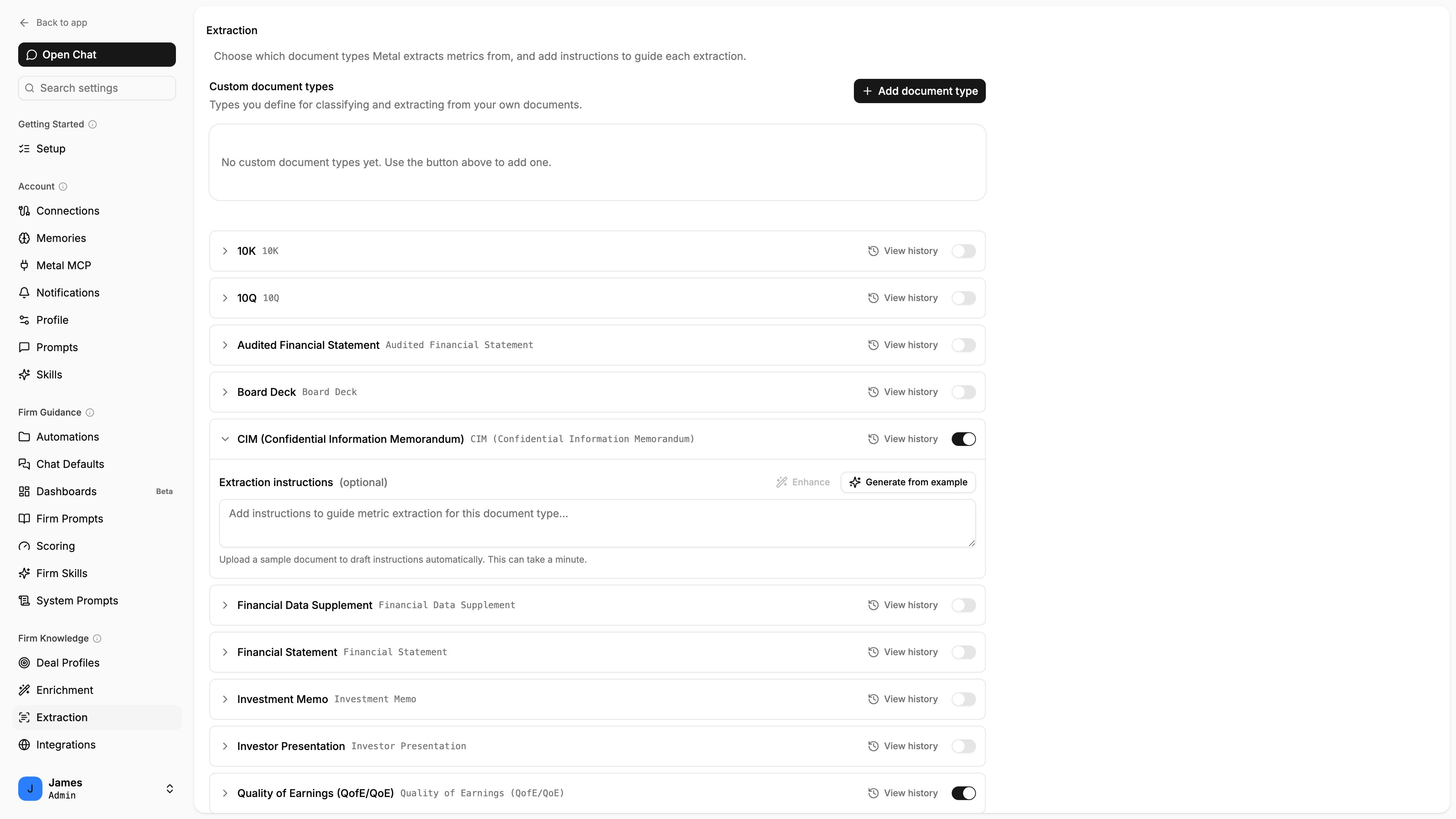 For each document type — built-in or custom — admins can also narrow **which** financial metrics Metal extracts from that type. Expanding a type reveals a **Metrics to extract** checklist of every supported metric. Leaving everything checked (the default) keeps the current behavior of extracting every supported metric. Unchecking a metric tells Metal to skip it for that document type; clearing every metric effectively disables extraction for the type. Changes take effect on the next run, including reruns of existing CIM screenings, which rebuild the extraction prompt from the updated selection.
## Enrichment timestamps
Companies carry timestamps that tell you the state of enrichment:
| Field | Description |
| ------------------------- | ------------------------------------------------ |
| `lastEnrichmentStartedAt` | When the most recent enrichment run began. |
| `lastEnrichedAt` | When enrichment last completed and wrote values. |
If `lastEnrichmentStartedAt` is newer than `lastEnrichedAt`, a run is in progress.
## Enriching in bulk
To enrich many resources at once, add them to a [list](/api-reference/introduction) and trigger enrichment at the list level. Lists are the spreadsheet-like surface for working with resources in bulk, including computing enriched columns across every entry.
## Best practices
Create a company with at least a `canonicalName` (and a `website` when you have one) before enriching for the best match.
Trigger enrichment and check back later; don't hold a request open waiting for results.
The more identifying detail you supply (website, location), the more accurate enrichment is.
Use lists to enrich large sets efficiently instead of looping one-by-one.
For each document type — built-in or custom — admins can also narrow **which** financial metrics Metal extracts from that type. Expanding a type reveals a **Metrics to extract** checklist of every supported metric. Leaving everything checked (the default) keeps the current behavior of extracting every supported metric. Unchecking a metric tells Metal to skip it for that document type; clearing every metric effectively disables extraction for the type. Changes take effect on the next run, including reruns of existing CIM screenings, which rebuild the extraction prompt from the updated selection.
## Enrichment timestamps
Companies carry timestamps that tell you the state of enrichment:
| Field | Description |
| ------------------------- | ------------------------------------------------ |
| `lastEnrichmentStartedAt` | When the most recent enrichment run began. |
| `lastEnrichedAt` | When enrichment last completed and wrote values. |
If `lastEnrichmentStartedAt` is newer than `lastEnrichedAt`, a run is in progress.
## Enriching in bulk
To enrich many resources at once, add them to a [list](/api-reference/introduction) and trigger enrichment at the list level. Lists are the spreadsheet-like surface for working with resources in bulk, including computing enriched columns across every entry.
## Best practices
Create a company with at least a `canonicalName` (and a `website` when you have one) before enriching for the best match.
Trigger enrichment and check back later; don't hold a request open waiting for results.
The more identifying detail you supply (website, location), the more accurate enrichment is.
Use lists to enrich large sets efficiently instead of looping one-by-one.